Bodrum Castle

History, architecture and visitor information for Bodrum’s Castle of St. Peter.

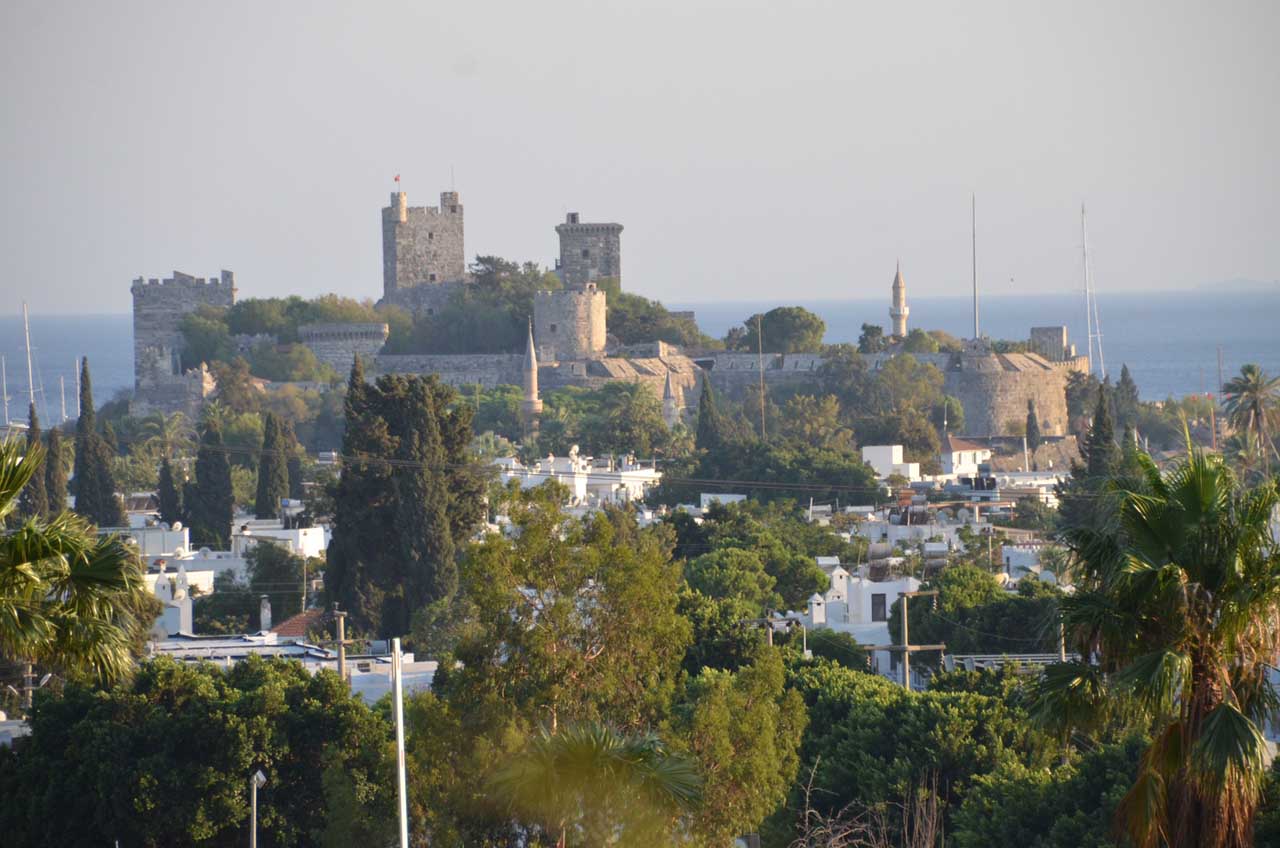
Bodrum Castle, also known as the Castle of St. Peter, is a medieval fortress and the most significant historical landmark of Bodrum.
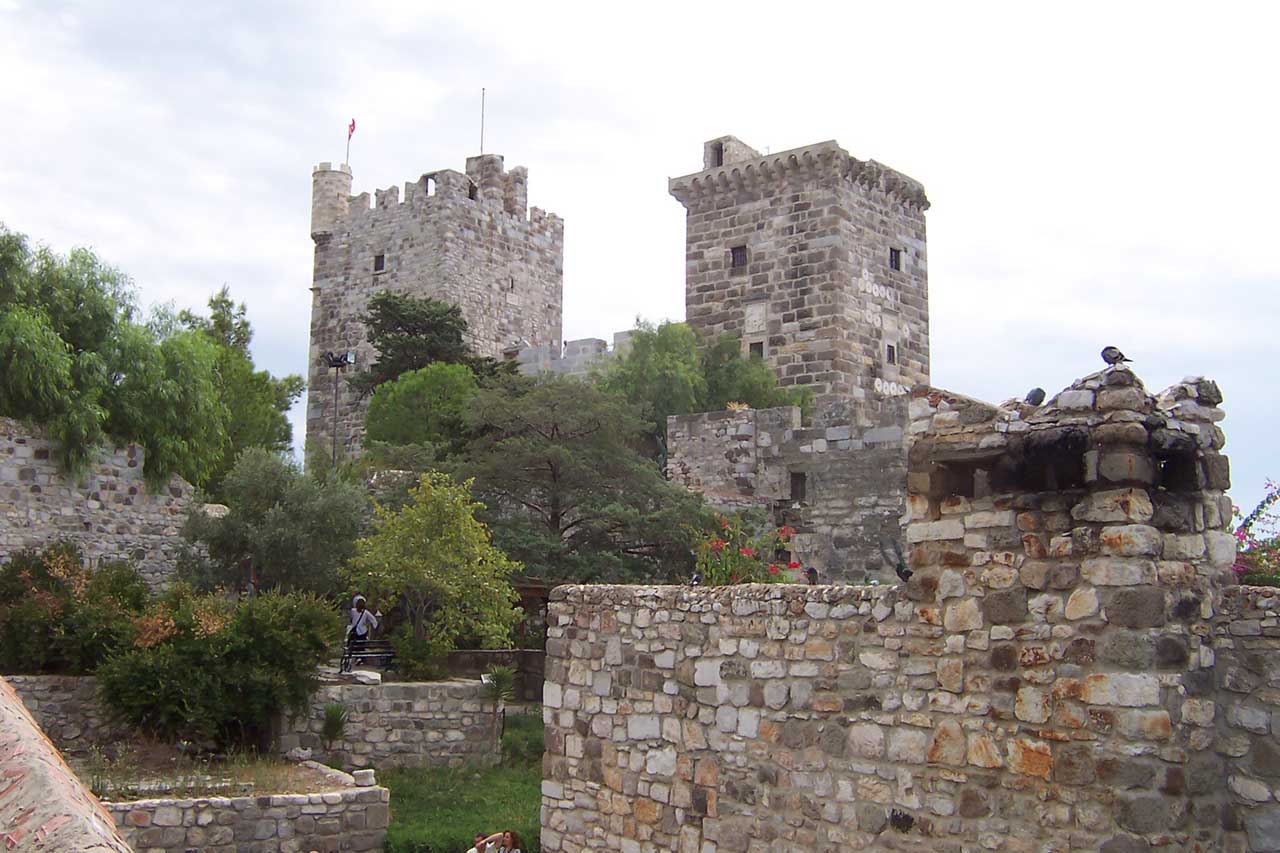
Bodrum Castle
Bodrum Castle | Credit: Dean Sas

Occupying a prominent position at the entrance to Bodrum Harbor, the castle was built in the 15th century by the Knights of St. John to defend against maritime incursions in the eastern Mediterranean.

The castle was repurposed in 1962 when the Turkish government transformed it into a repository for the region’s maritime excavations.

The Bodrum Museum of Underwater Archaeology, housed within the castle walls, is part of the site included on Türkiye’s UNESCO World Heritage Tentative List.

It is internationally recognized for its extensive collection of artifacts recovered from underwater sites, including Bronze Age shipwrecks such as the Uluburun.

Today, Bodrum Castle functions both as a preserved example of Crusader-era military architecture and as a major center for underwater archaeological research and exhibition.

The castle is a historical monument, with its grounds used to display a Mediterranean botanical garden. Its towers and halls hold collections of shipwreck artifacts, pottery, glass, jewelry, and coins.

FactDetail
Also known asCastle of St. Peter
LocationBodrum Harbor
Built byKnights of St. John
Period15th century
Later useOttoman garrison and prison
TodayCastle and museum site
UNESCO statusTentative List
Visit time2 to 3 hours

What visitors should understand

Known as the Castle of St. Peter, Bodrum Castle is referred to in Latin as Sanctum Petrum. This term later evolved into the medieval name of Petronium.

The Knights of St. John (Knights Hospitaller) built the castle between 1406 and 1523 as a refuge for Christians in Asia Minor.

The Knights, who belonged to a prominent Catholic military order, named the fortress in honor of the apostle, Saint Peter.

Bodrum Castle dominates the waterfront and marina, making it a primary navigational landmark visible from almost everywhere in the city.
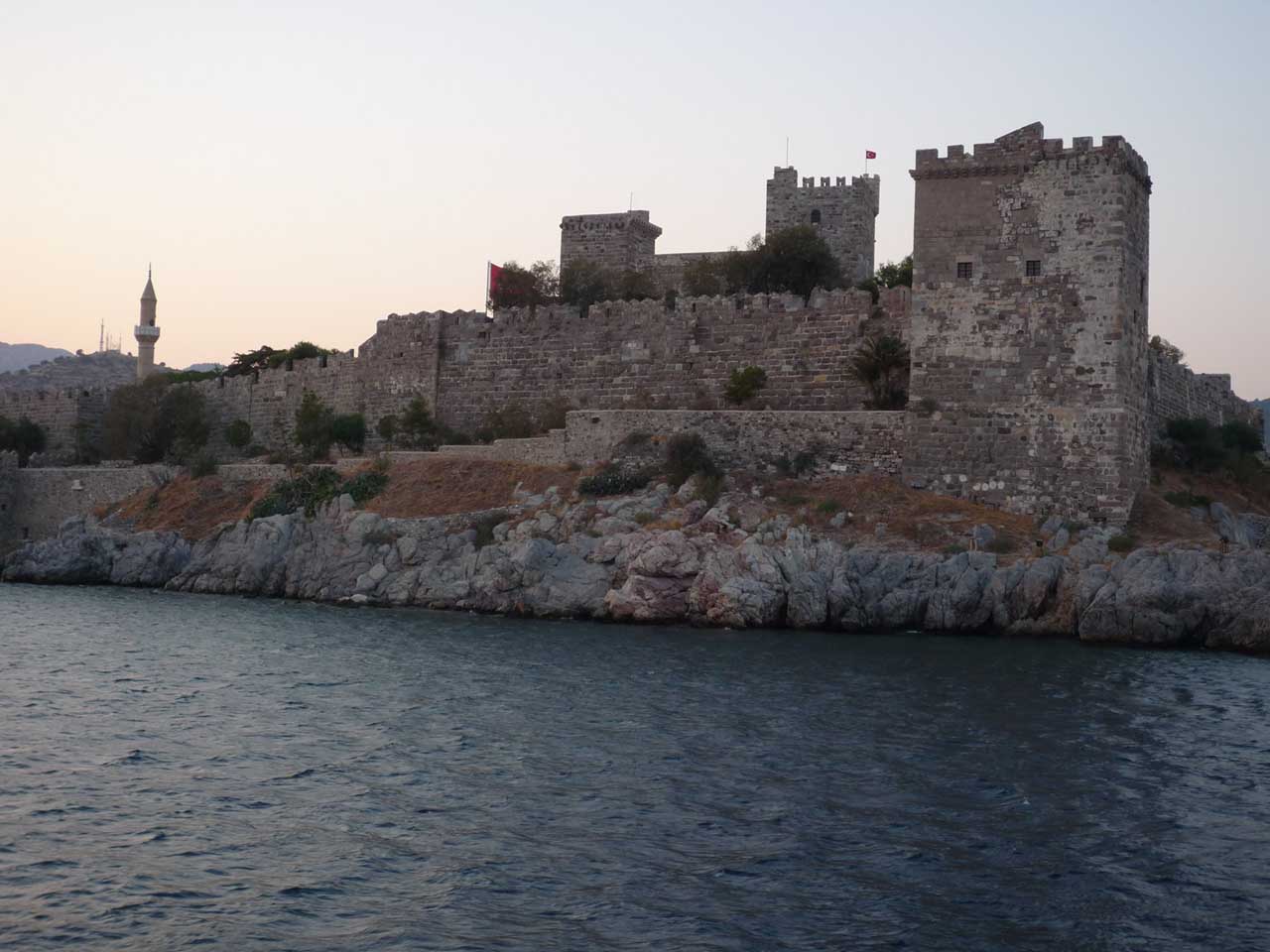
View of Bodrum Castle from the water
View of Bodrum Castle from the water | Credit: John Constable


After the Knights of St. John lost Rhodes in 1522, Bodrum Castle came under Ottoman control. It served as a military garrison and mosque, later became a prison, and eventually became a national monument and the Museum of Underwater Archaeology.

Bodrum Castle has been included on the UNESCO World Heritage Tentative List since 2016.

The buildings of Bodrum Castle are historically and functionally intertwined. With one entry ticket, a visitor gains access to both the grounds and the Mediterranean botanical garden, as well as the museum exhibits. This offers a seamless walking tour, rather than two separate outings.
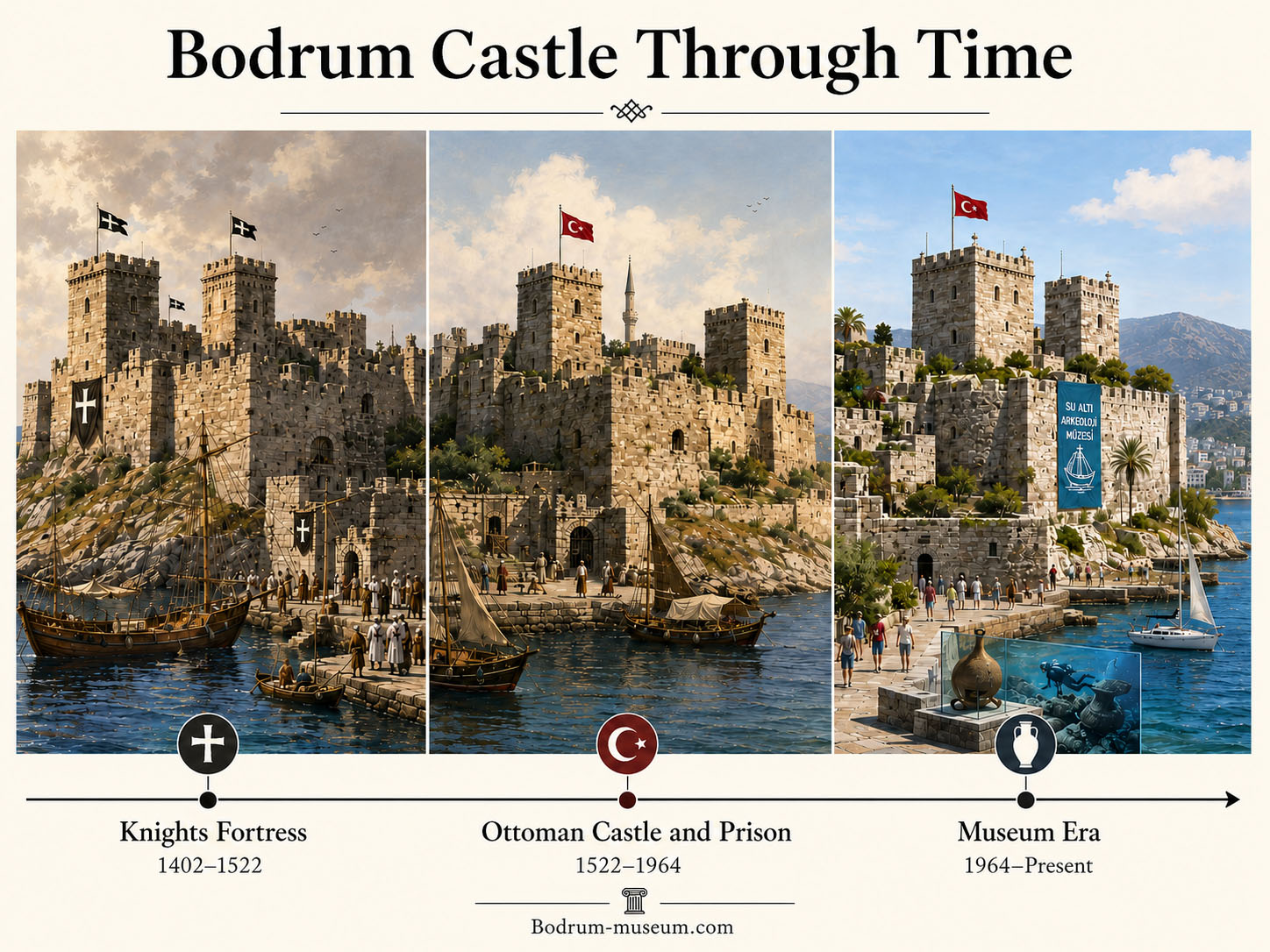
Bodrum Castle through time illustration - Bodrum-museum.com
Bodrum Castle through time: Knights of St. John fortress, Ottoman stronghold and prison, and modern museum era.

Where Bodrum Castle stands: the site, the harbor, and ancient Halicarnassus

Bodrum Castle is constructed on a rocky peninsula, surrounded by the Aegean Sea on three sides. Its location was selected to guard the entrance to Bodrum’s sheltered bays from naval attacks and to control maritime trade. Jutting out into the Aegean Sea, the castle sits between the city’s two harbors.

The castle peninsula was known in antiquity as Zephyrion, or Zephyria. The nearby ancient city of Halicarnassus grew into today’s coastal hub of Bodrum. Halicarnassus is renowned as the birthplace of Herodotus, an ancient historian, and as the site of the Mausoleum, one of the Seven Wonders of the Ancient World.

Bodrum Castle anchors the city’s identity. The imposing structure that dominates the city’s skyline bridges millennia of history.

Bodrum Castle View
Bodrum Castle View | Credit: Chris Devers

The Castle of St. Peter and the Knights of St. John

The Knights of St. John, also known as the Knights Hospitaller, were a powerful Catholic military order that occupied Bodrum Castle from the early 15th century until 1523. They used the fortress as a key stronghold on the mainland to defend their territories and safeguard Christian travelers in the eastern Aegean.

The Knights operated the fortress in Bodrum as an outpost of their Rhodes-based order. The Greek island of Rhodes served as their territorial stronghold for over two centuries, from 1310 until 1522.

Historically known as the Castle of St. Peter, the Bodrum fortress was vital to the Knights Hospitaller as it provided a strategic mainland stronghold. Bodrum Castle was ideally located in the Aegean shipping lanes, guarding the crucial eastern flank of the Rhodes headquarters.

Grand Master Philibert de Naillac (1396-1421) of the Knights Hospitaller spearheaded construction in the early 15th century. Under his leadership, the order created a strategic mainland fortress, and famously repurposed marble and reliefs from the nearby Mausoleum of Halicarnassus to fortify the stronghold.

Facing advancing Ottoman territories, the Knights of St. John needed a strong mainland outpost, and Grand Master de Naillac identified the rocky peninsula at Bodrum as the ideal location for a fortress.

How Bodrum Castle was built: walls, gates, towers, and defensive design

Bodrum Castle was specifically planned and built as a formidable military and defensive complex. It was constructed to serve as a strategic Crusader stronghold and a refuge for Christians in Asia Minor. It is a masterpiece of medieval military architecture, incorporating strategic elements to neutralize attackers and maximize self-defense.
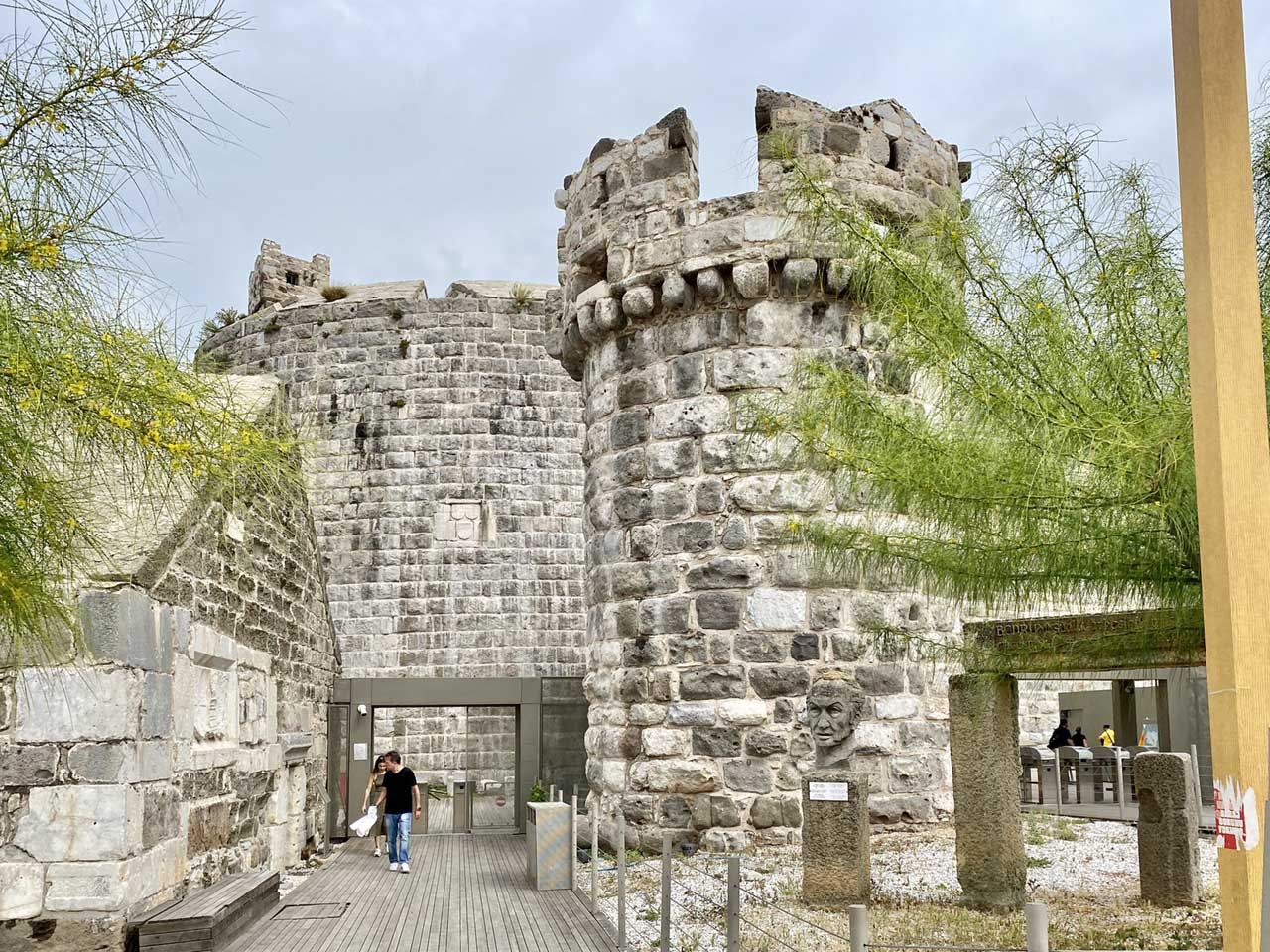
Bodrum Castle walls
Bodrum Castle, Bodrum, Turkiye | Credit: Warren LeMay


Facing land on its northern and western flanks, the castle has thick, fortified double walls. A moat was dug in front of the northern walls, separating the castle from the mainland to prevent attackers from tunneling beneath the foundations or using siege towers.

The inner sanctums of the fortress were guarded by seven distinct gates, fortified with drawbridges and drop doors.

The castle has five main towers: English, French, Italian, German, and Spanish, each built by those European divisions of the Knights of St. John. The towers feature sloped, reinforced bases designed to deflect early cannon fire.

The inner passages of the castle were engineered as zigzagging paths, creating steep, winding corridors that forced attackers into exposed zones. Not only did this slow down advances, but it also made it nearly impossible for large numbers of enemies to breach the fortress.

The sea-facing walls of the castle were less well fortified, as the Knights of St. John had a dominant naval fleet and had little fear of sea attacks.
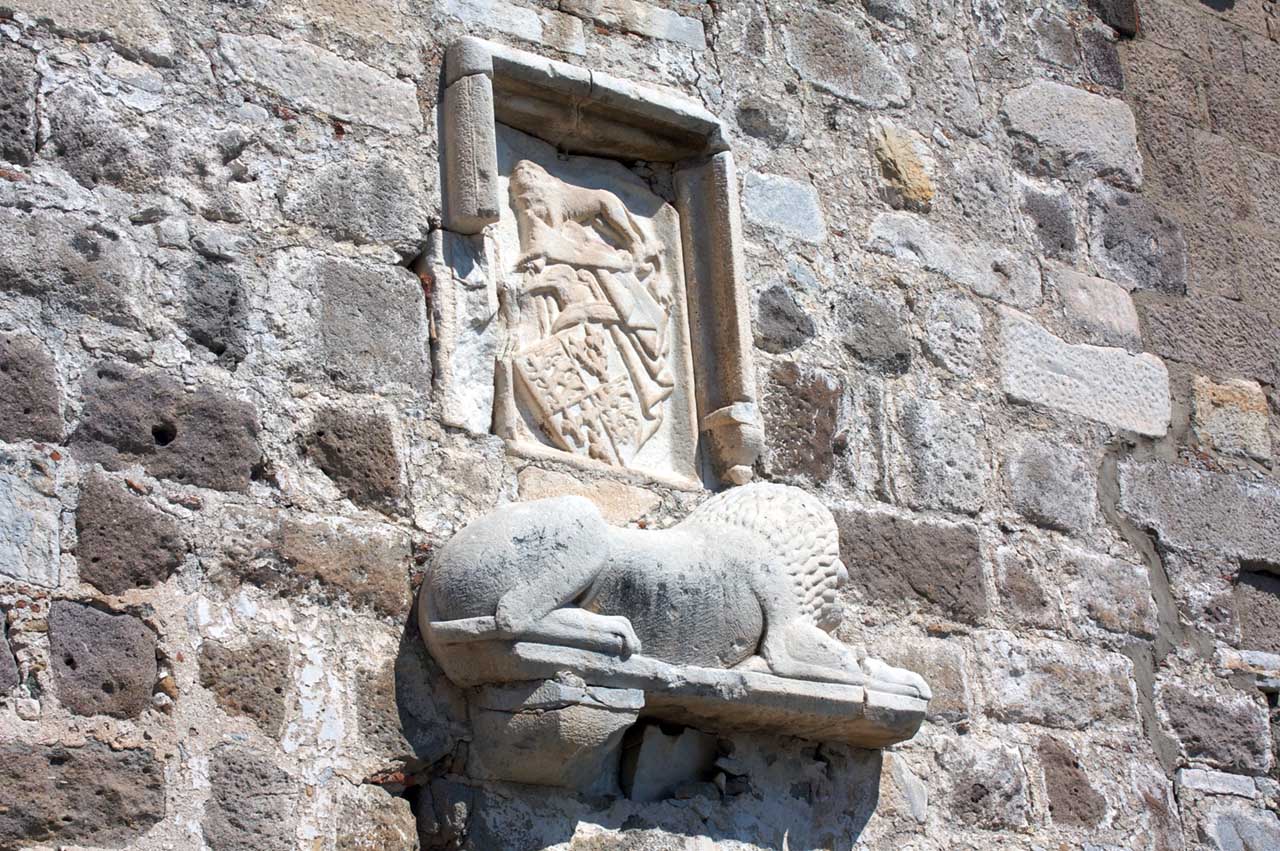
Bodrum Castle stone wall details
Bodrum Castle stone wall details | Credit: Benjamin Claverie


Bodrum Castle is renowned for its square, Gothic-inspired layout. The medieval complex was planned on a roughly 180-by-185-meter footprint, and its massive walls incorporate remnants of the ancient Mausoleum of Halicarnassus.

The seven gates forced attackers to navigate a labyrinth of heavily fortified winding corridors, leaving them exposed to retaliation by arrows, stones, and boiling oil.
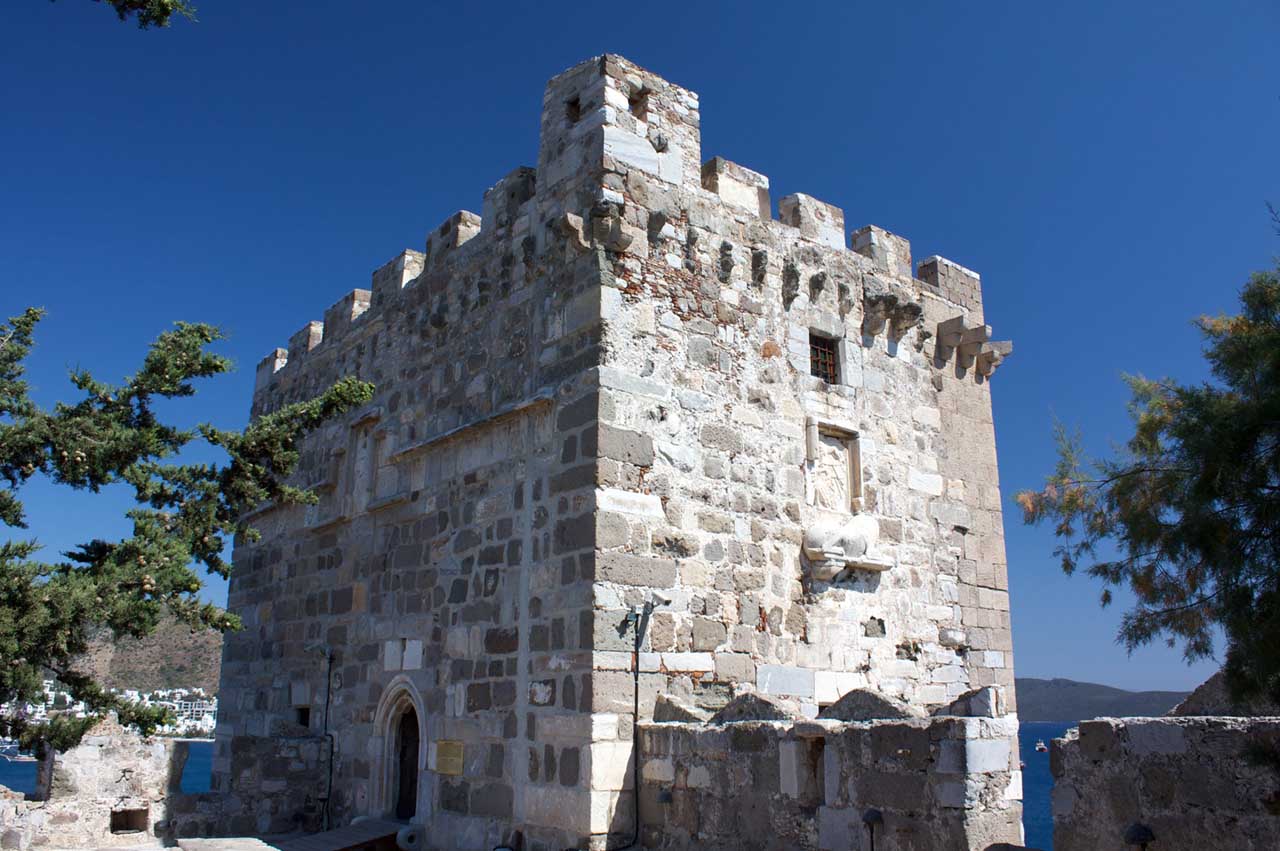
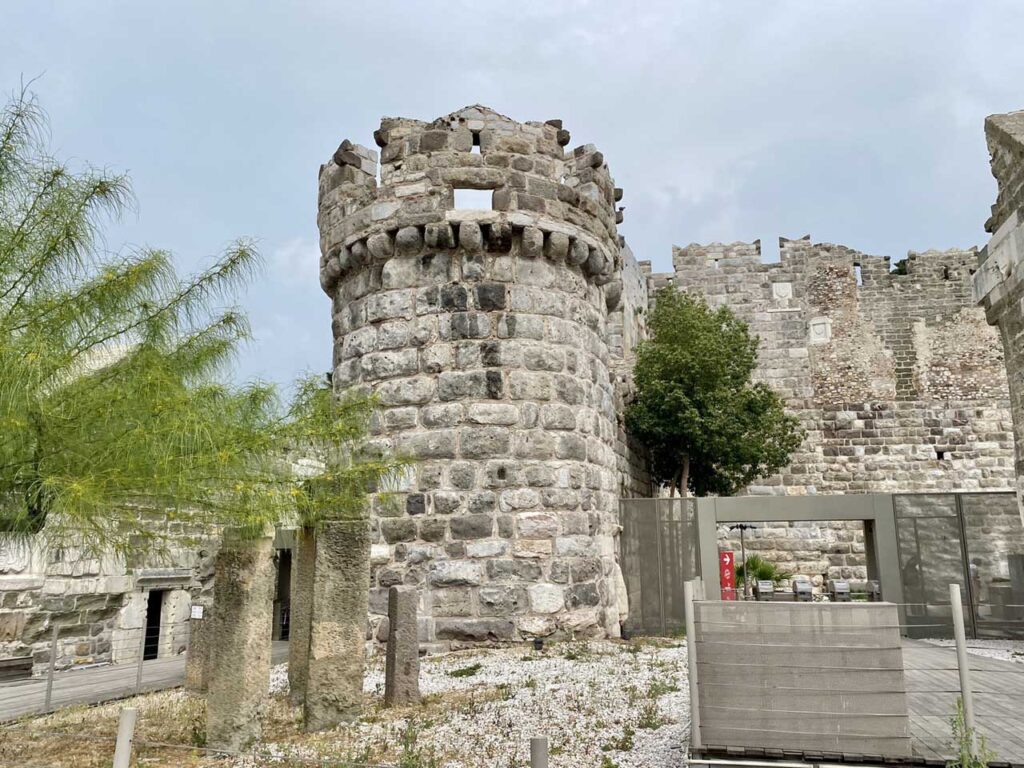
The towers of Bodrum Castle: the nations of the fortress

The five main towers are the English, French, German, Italian, and Spanish towers.

They are key to understanding Bodrum Castle, as they physically reflect the multinational powers, cultural diversity, and architectural history of the Knights of St. John.

Known as the Lion Tower, the English tower is located in the southeast corner and was originally accessed by a drawbridge.

The entrance features a prominent carved marble relief of a British lion, while the interior holds displays of artifacts recovered from ancient shipwrecks.

The French tower is known as the Embroidery Tower and is situated at the highest point of the castle. Its interior houses a vast collection of amphoras, Greek or Roman ceramic vessels used in the ancient Mediterranean.

The Strong Tower represents the Germans, featuring solid masonry. The interior contains displays of the Uluburun shipwreck, one of the world’s oldest known shipwrecks, dating to the 14th century BC.

Known as the Relief Tower, the Italian Tower was constructed as a sturdy defensive post. It houses exhibitions of pottery, glass, and bronze artifacts dating to the Classical and Hellenistic periods.

The Spanish Tower is known as the Serpent Tower with a snake motif carved into the walls. The tower displays items from the Carian Princess era, a period in the ancient Anatolian region of Caria.

The Spanish Knights of St. John also built a chapel on the castle grounds, which was later converted into a mosque during Ottoman rule.

The identity of Bodrum Castle is defined by its extensive medieval heraldry, featuring nearly 250 carved coats of arms, religious symbols, and reliefs created by the multinational Knights of St. John.

Bodrum Castle Tower
Bodrum Castle tower | Credit: Benjamin Claverie
Tower,Bodrum Castle
Bodrum Castle Tower | Credit: Warren LeMay

From medieval fortress to Ottoman stronghold, prison, and military site

Bodrum Castle was an outlying stronghold for the Knights of St. John. However, after Sultan Suleiman the Magnificent defeated their main headquarters on the Greek island of Rhodes in December 1522, the Knights had to surrender the fortress. Bodrum’s surrender removed a key remaining Hospitaller stronghold on the Anatolian coast and strengthened Ottoman control in the Aegean.

Immediately after the Knights of St. John surrendered the fortress in 1523, the Ottomans converted the chapel inside Bodrum Castle into a mosque. They added a minaret and named it Suleimaniye Mosque in honor of Sultan Suleiman the Magnificent.

After the Knights Hospitaller surrendered Bodrum to Suleiman the Magnificent, the Ottomans took control of the castle and the garrison served as a small military outpost and regional defensive base for several centuries.
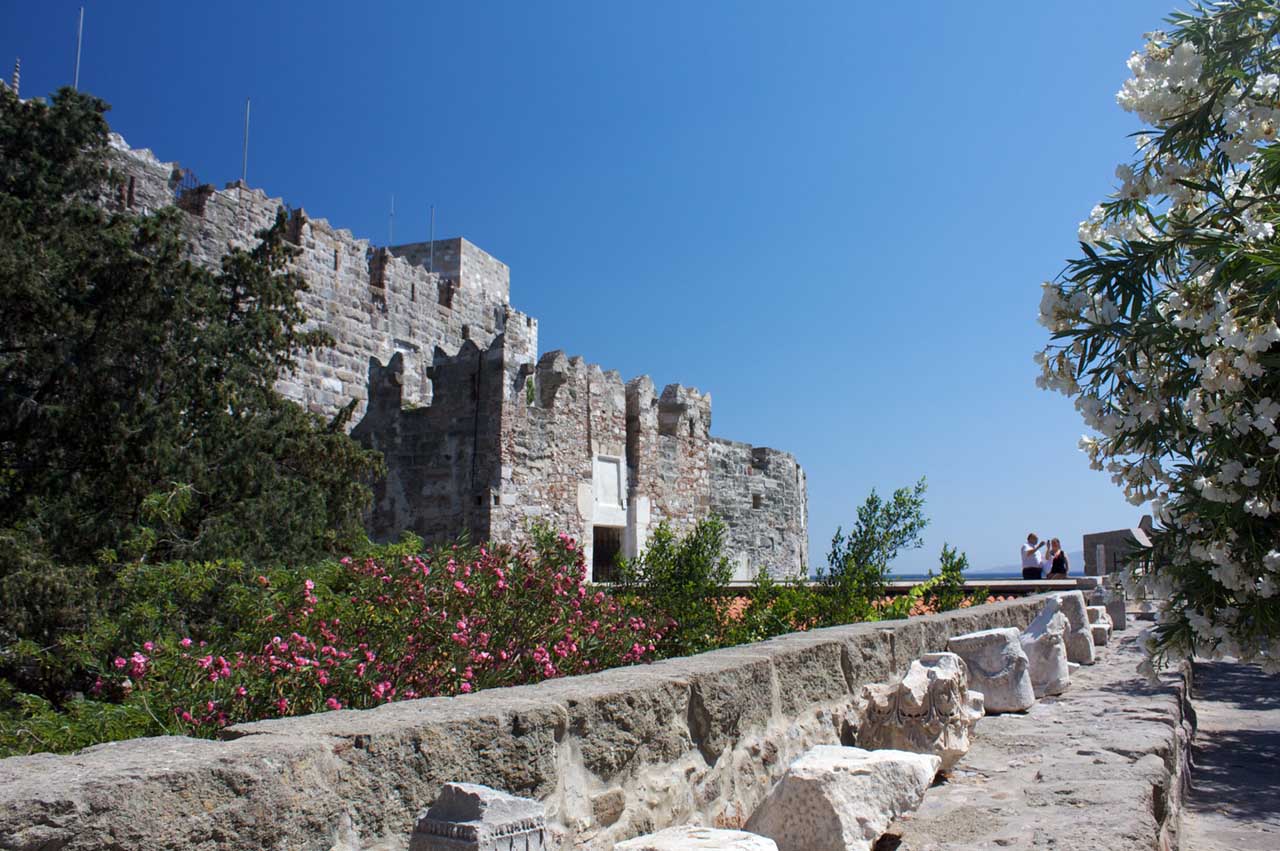
Bodrum Castle, the second defensive layer
Bodrum Castle, the second defensive layer | Credit: Benjamin Claverie


In 1895, the Ottoman Empire repurposed the fortress into a prison for political detainees and other inmates. It continued to operate as a prison until 1915, when a naval bombardment by the French during World War I badly damaged the castle, forcing its evacuation.

At the end of World War I, the region was occupied by Italian forces who used Bodrum Castle as their military headquarters. However, the Italians were driven out during the Turkish War of Independence in 1921.
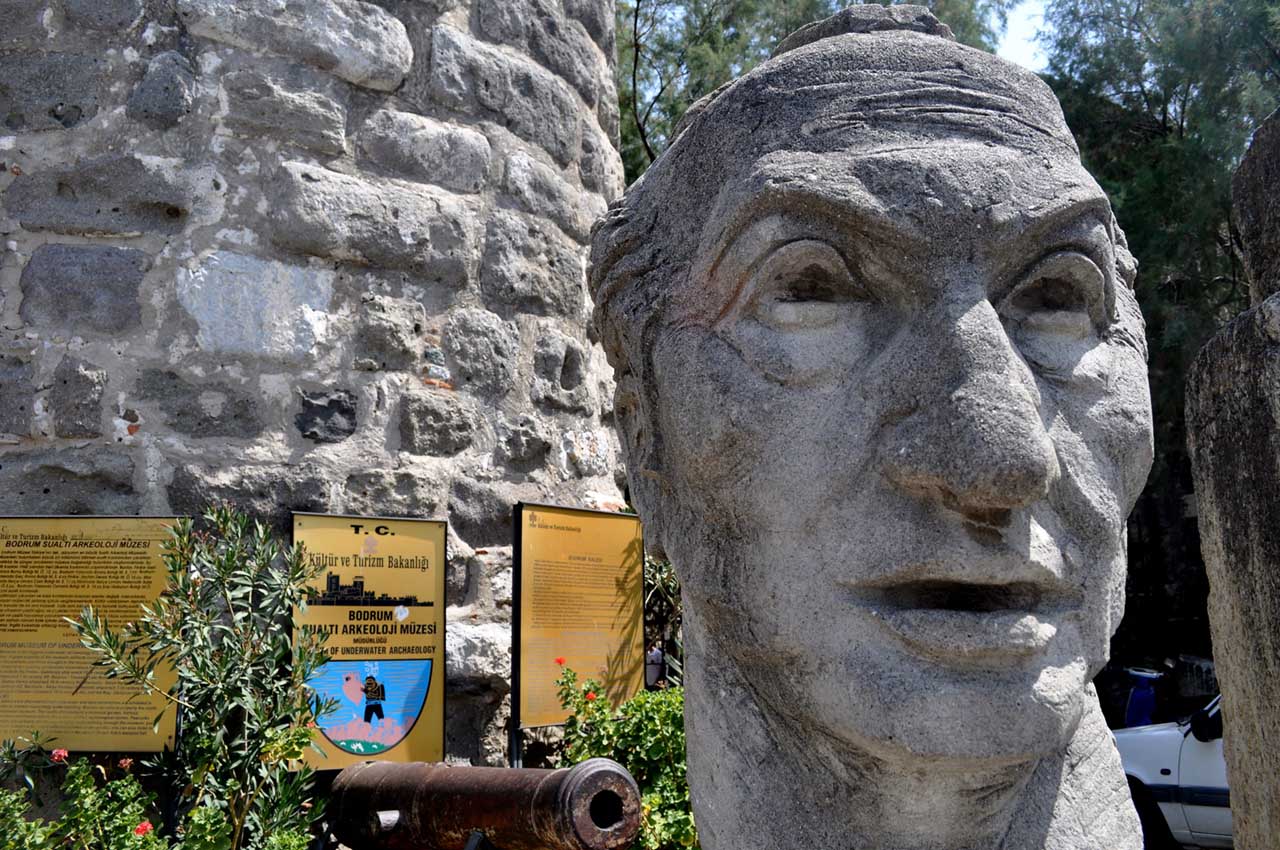
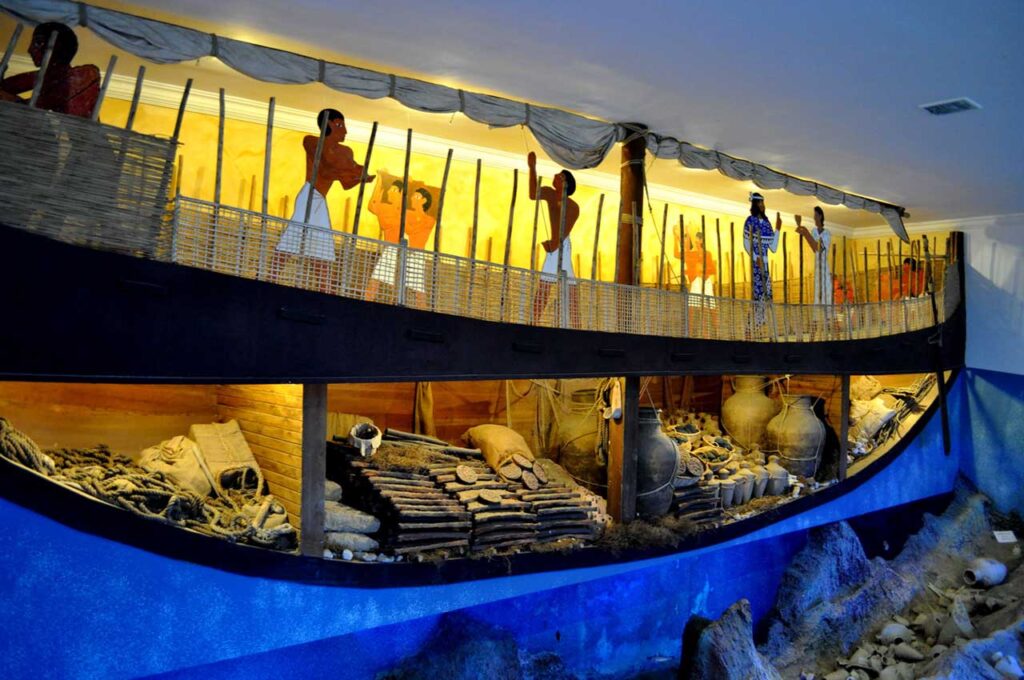
The modern rescue of Bodrum Castle: restoration and the birth of the museum

The modern identity of Bodrum Castle relies entirely on its restoration and conversion into the Bodrum Museum of Underwater Archaeology.

Once a decaying 15th-century Crusader fortress used as an Ottoman prison, the structure was repurposed in the 1960s to bridge medieval military history with some of the world’s oldest submerged treasures.

The Bodrum Museum of Underwater Archaeology was established in 1964 in the 15th-century Castle of St. Peter, becoming one of the world’s most significant museums dedicated to underwater archaeology.

Initially, the Turkish government focused on repairing the fortress walls and ruined towers. Once the structural restoration was complete, curators began converting available spaces and towers into the 14 exhibition halls on display today.

Bodrum Castle’s transformation into an underwater archaeological museum turns underwater discoveries into historical records. The specialized museum synthesizes snapshots of ancient trade and daily life into a tangible, real-world setting, displaying maritime heritage and providing insight into past civilizations.

Bodrum Castle and the Museum of Underwater Archaeology: how they fit together

Bodrum Castle and the Bodrum Museum of Underwater Archaeology are not the same thing, but they are experienced together as a single destination.

Also known as the Castle of St. Peter, it is a 15th-century medieval fortress built by the Knights of St. John, while the Bodrum Museum of Underwater Archaeology is world-renowned and housed within the castle walls.

A single entry ticket grants access to both the medieval architecture and the ancient maritime exhibits. The grounds and towers offer profound insight into both medieval European history and ancient civilizations.

The Gothic architecture of the castle incorporates stones from the ancient Mausoleum of Halicarnassus.

The museum utilizes the historic towers, chapels, and courtyards for underwater exhibits, blending the ambiance of a medieval fortress with thousands of years of Mediterranean maritime history, while offering sweeping panoramic views of the yacht-filled Aegean harbor.

The museum features thousands of relics recovered from underwater excavations along the Turkish coast in 14 dedicated exhibition areas.

These exhibits include the remarkably preserved 14th-century Bronze Age Uluburun shipwreck; the Serce Limani Glass Wreck, featuring an 11th-century Byzantine ship with its three-ton cargo of intact and broken Islamic glassware; and the Carian Princess Hall, displaying the beautifully preserved skeleton and exquisite gold jewelry of a noblewoman from between 320 and 325 BC.

Bodrum Museum
Bodrum Museum | Credit: Panegyrics of Granovetter
Bodrum Museum
Bodrum Museum | Credit: Panegyrics of Granovetter

What to see inside Bodrum Castle today

The Amphora Exhibition is part of the renowned Bodrum Museum of Underwater Archaeology and features one of the world’s largest and most important collections of ancient amphorae. The exhibit showcases shipping and storage vessels from the 16th century BC through the 16th century AD.

The Glass Hall and Glasswreck Hall are two of the most spectacular exhibits, showcasing some of the rarest, oldest, and most valuable ancient glass collections in the world.

The Uluburun Shipwreck Hall displays finds from a remarkably preserved 14th-century BC Bronze Age merchant vessel. Exhibits of its cargo and artifacts are considered one of the most important maritime archaeological discoveries in history.

The Tektaş Shipwreck is a 5th-century BC Classical Greek merchant vessel that sank between 440 and 425 BC off the rocky headland of Tektaş Burnu on the western coast of Türkiye. It is one of the most important Classical Greek shipwrecks excavated in Aegean waters.

The Carian Princess exhibit features the 4th-century BC remains and golden burial treasures of an ancient noblewoman.

The Coins and Jewelry Hall at Bodrum Castle is housed in the historic Italian Tower and showcases a fascinating collection of ancient currencies and personal ornaments recovered from land excavations and the region’s famous underwater shipwrecks.

The castle dungeon is a labyrinthine, historically notorious holding area, designed with thick ramparts and numerous steps to maximize isolation and prevent escape.

The Turkish Bathhouse illustrates traditional Ottoman hamam culture, featuring elements like a heated marble slab where visitors received scrub and foam massages.

The Commandant’s Tower preserves the memory of Lt. Ibrahim Nezihi, an Ottoman Turkish officer and former commandant of Bodrum Castle, whose personal memorabilia and antiques were donated to the museum by his daughter.

SectionWhat it shows
Amphora ExhibitionAncient storage vessels
Glass HallAncient glass objects
Glasswreck HallByzantine ship cargo
Uluburun Shipwreck HallBronze Age shipwreck finds
Tektaş ShipwreckClassical Greek shipwreck finds
Carian Princess exhibitBurial treasures and remains
Coins and Jewelry HallAncient currencies and ornaments
Castle dungeonHistoric prison space
Turkish BathhouseOttoman hamam culture
Commandant’s TowerOttoman military memorabilia

Why Bodrum Castle is on the UNESCO Tentative List

A UNESCO Tentative List is a country’s official list of cultural, historical, or natural sites that it may nominate for UNESCO World Heritage status.

Bodrum Castle is recognized on the UNESCO World Heritage Tentative List because of its value as a well-preserved medieval Crusader fortress, its multinational Gothic architecture, and its direct historical connection to one of the Seven Wonders of the Ancient World.

Because the Knights of St. John were a multinational organization, the castle was divided and built according to the Order’s various national groups, and features distinct towers funded and constructed by the English, French, German, Italian, and Spanish.

The castle’s physical structure and the museum’s 14 exhibition halls blend 15th-century European Gothic architecture, centuries of Ottoman modifications, and the modern transformation into a major archaeological institution.

Surrounded by the Aegean Sea on three sides, Bodrum Castle overlooks the natural harbor. This maritime positioning allowed it to protect against naval invasions and monitor regional trade routes.

How to visit Bodrum Castle: route, timing, and what to expect

Exploring Bodrum Castle offers a rewarding but physically demanding adventure. Visitors are required to navigate a sprawling, multi-level fortress built on a rocky peninsula. The castle, with its vast courtyards, contains more than 250 coats of arms.

The 15th-century fortress has uneven terrain, numerous steep climbs, and deep stone steps. Visitors can expect to traverse slick, polished stone paths, narrow corridors, and multiple levels to access the various exhibition halls and panoramic viewpoints.

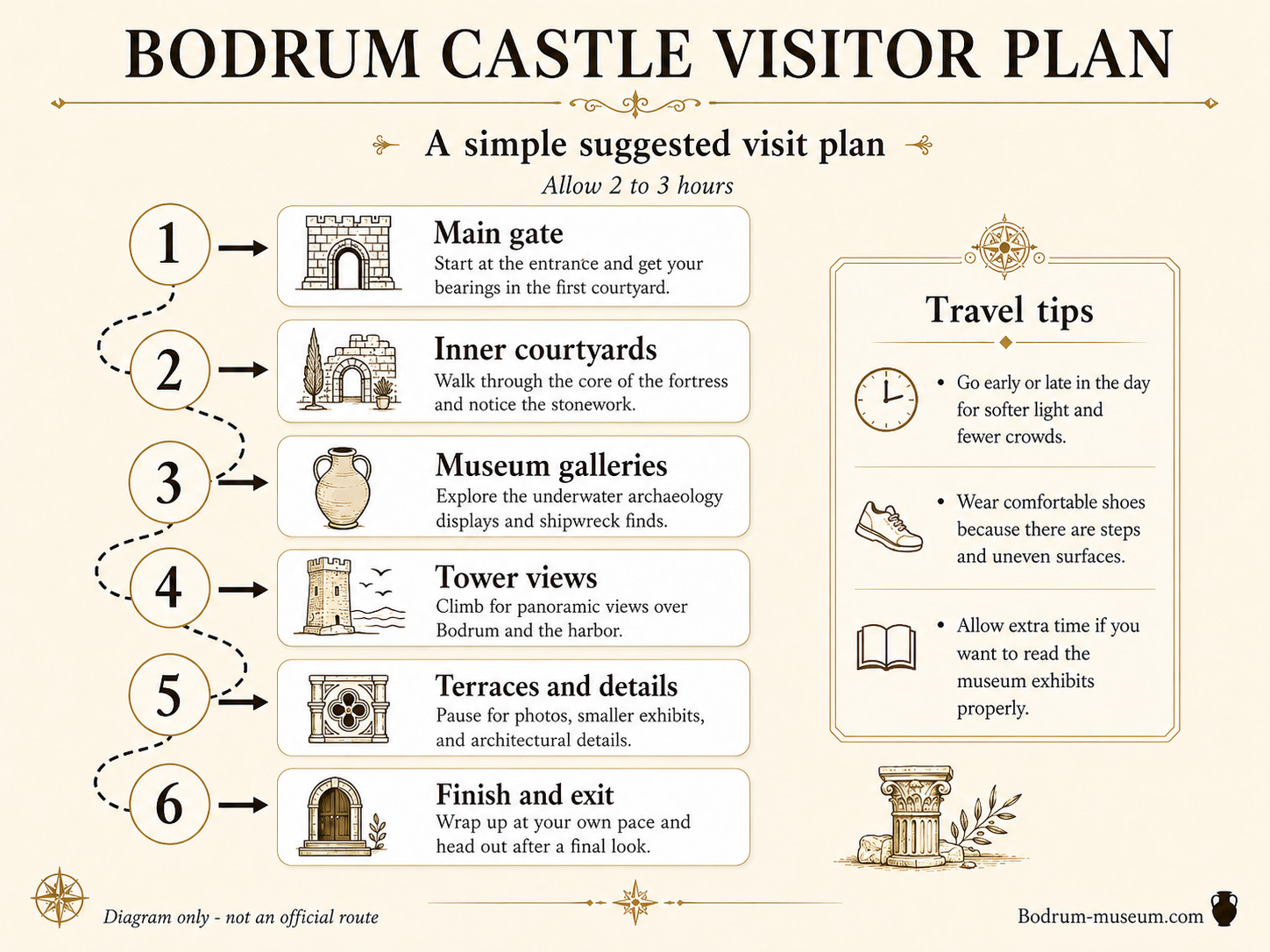
Explore the castle by following a loop that moves from the waterfront, up through the fortress towers, and across the outdoor exhibits.

To reach the inner keep and the museum exhibits, visitors must navigate a deliberate, uphill sequence of seven gates along a zigzag ramp before reaching museum halls and shipwreck exhibits.

The fortress is defined by its five main towers, each designed, financed, and named after the various European nations that made up the Knights of St. John.

The Upper Courtyard and Gardens are filled with lush Mediterranean flora, including centuries-old olive trees, pomegranates, and myrtle.

The castle is a spectacular vantage point, offering sweeping, 360-degree panoramas of the deep-blue Aegean Sea and bustling Bodrum Marina, with many photographic opportunities.

A 1.5-hour walkthrough of Bodrum Castle is insufficient to properly enjoy the grounds, the monument, and the museum. Visitors should set aside at least 2 to 3 hours when planning their tour.

To combat the Aegean heat, visitors are advised to wear comfortable, sturdy footwear to navigate the uneven, historic stone paths. Wear lightweight clothing and a hat for sun protection, and stay hydrated with bottled water.

Bodrum Castle visitor plan illustration
A simple suggested visitor plan for Bodrum Castle. Diagram only, not an official route.

Tickets, opening hours, and visitor information

Bodrum Castle is generally open daily, though operating hours vary by season and may change for evening museum programs. It is recommended to check the official website for the most up-to-date hours and ticket options before your visit.

One entry ticket gives visitors access to both Bodrum Castle and the Museum of Underwater Archaeology.

The castle is located in the heart of Bodrum, on the waterfront at the entrance of the main harbor, and is easily accessible on foot.

Check the latest opening hours before your visit.

How long to spend at Bodrum Castle

Visitors should set aside sufficient time to view the points of interest.

One to one and a half hours is enough time for those wanting a quick tour of the castle and main museum highlights.

Two hours is the preferred time for a first-time visit.

For those especially interested in the museum aspects and historical details, planning for at least three hours is recommended. The extensive collections and immersive setting of this medieval fortress deserve ample time to explore fully and appreciate the thousands of artifacts on display.

Frequently asked questions

Is Bodrum Castle the same as the Bodrum Museum of Underwater Archaeology?

Not exactly. The Bodrum Museum of Underwater Archaeology is housed within Bodrum Castle.

What is Bodrum Castle also called?

It is also known as the Castle of St. Peter.

Who built Bodrum Castle?

The Knights of St. John.

Is Bodrum Castle on the UNESCO World Heritage List?

It is on the Tentative UNESCO World Heritage List.

How much time do you need at Bodrum Castle?

Two to three hours is best, though 1.5 hours can work for a quick visit.

Is Bodrum Castle worth visiting?

Yes. It blends centuries of medieval history with world-class ancient artifacts.

Where is the entrance to Bodrum Castle?

The entrance to Bodrum Castle is located on the waterfront, at the eastern edge of the main marina.

Can you visit Bodrum Castle without seeing the museum?

Yes, but the museum is integrated into the castle’s towers and courtyards, making them difficult to separate.

Sources and references

The information on this page is based on official museum information from UNESCO and the Turkish Ministry of Culture, underwater archaeology sources, and established historical/travel-history references.

You can find the website sources and references page here.

Conclusion

  • Bodrum Castle is the main historic monument of the Turkish city of Bodrum.
  • Its importance lies in the overlap of medieval fortress architecture, the history of the Knights of St. John, Ottoman reuse, modern restoration, and underwater archaeology.
  • For most visitors, the best way to understand Bodrum Castle is to treat the excursion as both a castle and a museum visit.