
Bathing facilities back in the era where the Knights of St. John ruled the land weren’t very common and were actually rare.
People back then didn’t actually believe in bathing every single day and were prone to numerous infections and diseases. The Turkish bath exhibit is pretty new to the exhibit because not a lot is known about it and from what we know in history, some people simply didn’t believe in personal hygiene routines.
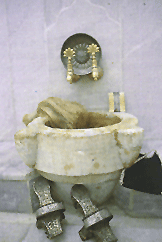
There’s not a lot of records or historical data available to help back the evidence of baths being used but when a Turkish traveler named Evilya Calebi visited Bodrum in 1671, he noted that there weren’t any baths being used or even accessible in the castle walls.
Even going back through historical notes that people have left behind, no one has been able to pin point exactly when these baths were established or used. Some people believe that it wasn’t until the end of the 19th century that baths became common in Bodrum.
It was believed at this time, that the 19th century is when the Bodrum castle acquired the very first Turkish bath facility.
However, the original and first facility didn’t last long as during the first world war, it was destroyed and unrepairable. Since then, the bath house has been restored to what researchers believe it originally looked like and features have been restored to reflect a realistic looking Turkish bath. We know a lot about Turkish culture but it’s hard to pin point exactly what this bath would have looked like.
The exhibit was opened precisely in 1991. It’s not uncommon back then that people had horrible personal hygiene or the people then flat out neglected to take care of their hygiene. It’s commonly noted in history that the Crusaders weren’t very big in hygiene nor did they believe in it. However, during this time, the Romans believed in a Roman bath tradition but it was on a relatively small scale. Western Europeans were some of the first ones to accept the tradition of bathing and cleaning their body.
However, there’s no official evidence that bathing stations were utilized or even existed when the Bodrum Castle was operational. A lot of researchers believe that the Turkish bath exhibit wasn’t actually a bath house but it was more or less a prison or holding room. Some people believe the bath house was built originally to be a bath house but shortly after became a prison due to the people’s lack of belief in person hygiene.
The castle officially became a prison in 1893 and some people believe it was directed by a man named Hoca Arif Efendi. This was a scholar who held his position in the Bodrum Castle from 1896 to 1897. One notable Bodrum Castle resident named Avram Galanti Bodrumlu stated that Hoca Arif Efendi was the one that wanted some iron pipes to be installed and that the water supply system needed to be replaced. This is why some people believe that a Turkish bath house at one point did exist and was utilized.
The exhibit however does illustrate a lot of origins and things that come from the Turkish tradition that would entail a realistic bathhouse. The exhibit entails a lot of Turkish bathing tradition which included some of the aspects of bathing we use today. The old Turkish bathing tradition included pouring water over your body, washing the body and then letting the water drain away right after it was used to avoid contact with dirty water. We call these showers today.
Also, some of the Turkish baths were some of the first rooms to use what we call today a steam room. These rooms would have circulated hot air that go into the floor and surround the room through the walls.
The point of this was to help open the pores up and cleanse the skin. Deep massages and skin scrubs were common in Turkish tradition even before the Turkish bath became a popular commodity. Also, there were Turkish dressing rooms that weren’t just known for their selection of clothing and changing your clothes but it was also a place of relaxation and cooling down once you came out of the hot room.
Some people would visit these places just to socialize. Gossiping between the locals was common in these rooms. The restoration of this exhibit and room was finished in 1991 and made available to public by the Ministry of Culture.
The Bodrum Lions Club also assisted in helping open this exhibit to the public along with the Administration of Circulating Capital Funds of the Ministry of Culture, the Directorate for Documentation of Monuments in Izmir and the General Directorate of Monuments and Museums.