
Located in between two very prominent bays stands the Bodrum Castle. The Bodrum Castle is a site of historical artifacts, knowledge and an in-depth look at history.
The construction of the castle was completed in 1522 but construction began in 1496 when the Knights of St. John decided to start building on the site, which was home to an ancient Turkish and Byzantine castle. The overall design and plan of the castle was designed as a square shape.
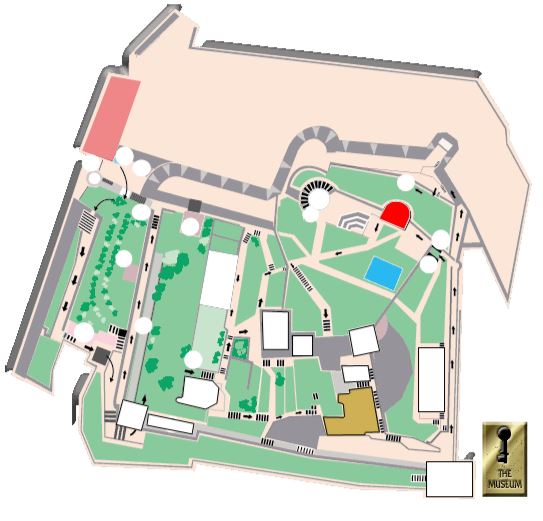
Aside from the rampart in the east, there’s a lot of fortifications that are strengthened by double layered walls in case of a bombardment. While the ramparts and walls facing the seas weren’t heavily fortified due to over confidence by the Knights, the walls that faced the main land were heavily fortified and usually double layered in case of attacks.
There’s five main towers that are part of the castle. The people of Bodrum know the towers by different names but here’s the main five towers of the castle:
- The English Tower (The Lion Tower)
- The French Tower (The Embroidery Tower)
- The Italian Tower (The Relief Tower)
- The German Tower (The Strong Tower)
- The Spanish Tower (The Snake Tower)
However, if you’re in-between the Snake Tower or the German Tower and take a look down between the moats, you can see that there’s two other towers, even though they’re a bit smaller in nature and not as significant. These two lesser known towers can be identified as the Caretto and the Gatineau. The Caretto was ordered to be constructed by a man named Fabrico Del Caretto (Grand Master) in the year 1513 and was constructed eventually in 1521.
The second tower known as the Gatineau Tower was completed in 1514 under the order of Jacques Gatineau. It was on the 29th of July in 1522 that a figure named Sultan Suleyman who was regarded as the Magnificent of the Ottoman Turks became highly suspicious of the Knights of St. John. They had become a figure that thought of themselves as invincible and that they couldn’t be touched.
The overall siege of the Knights lasted over 4 months and approximately 23 days exactly. During this deadly siege, both sides encountered significant casualties and losses.
During the eve of December 20 in 1522, there was an agreement signed that ended the siege and the war that had inflicted the loss of so many lives.
The agreement stated that with the Castle of Rhodes along with 12 other islands which include Istankoy and Bodrum Castle is to be handed over to the Turks in a period of only 10 days. The Bodrum Castle didn’t put up much of a struggle as they didn’t have much of a choice.
Once under control of the Turks, the torture room was then buried under thick concrete to never be seen again as it was seen as a “shameful room” where so many Turkish people were held prisoner and tortured. If you visit the Ganiteau, you’ll immediately notice three different coats of arms. One of those coats of arms belongs to Jacques Gatineau which was the person responsible for the construction of the castle who oversaw the operation.
To enter the tower, it’s easily accessible by a small flight of steps consisting of only 23 steps down. Once you reach the tower, you’ll notice an inscription right above the inner door which reads “INDE DEUS ABEST” which simply means that “God is absent from this place.” This is an eerie and horrible message that just gives you an idea of the things that went on in that place. Turks have more than a good reason to want this place erased from existence.
A lot of important and notable Turkish figures were held in this torture chamber during its lifetime, including Oruc Reis. Oruc Reis was the older brother of Admiral Barbaros. At a tremendous victory in Trablussam, he was on his way back home and was attacked by The Knights.
During that attack, his brother Llyas succumbed to his injuries and then Oruc was captured and tortured as a prisoner. It was noted that his hands and feet were bound as he was whipped with heavy chains and he was deprived of basic human rights, such as food and water for long periods of time.
A lot of people fought to end the cruel and unusual punishment of torture chambers and through the centuries, mankind wanted to make a difference in regards to how criminals were treated.
The Turkish people wanted to rid mankind of any torture devices that reminded them of cruelty, pain or inhumane justice which could be considered unusual and cruel. The Bodrum Castle has been opened and these doors or chambers serve as a painful reminder of a harsh and unusual time.