
The Bodrum Castle is in a slightly tricky landscape situation. On one side, you have an open land facing the castle which is prone to attack but on the other side, you have the sea which was not a well-guarded area.
The construction of this castle went from 1496 up until 1522 and was designed in such a way that it was fortified from any kind of landscape attack that enemies could throw at them.
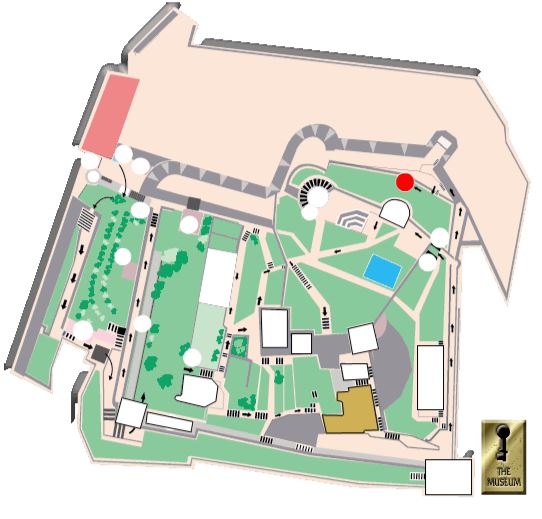
In the tower itself, there’s five main components of the overall design of the castle. By the people of Bodrum, the components of the castle are known by different names.
First, you have the English Tower which is known as The Lion Tower, you have the French Tower which is known as The Embroidery Tower, you have the Italian Tower which is known as the Relief Tower, you have the German Tower which is known as the Strong Tower and finally, you have the Spanish Tower which is known as the Snake Tower.
There are additional towers however if you’re in between the Snake Tower and The German Tower. You can identify these towers when looking down between the two and you’ll notice some smaller towers located inside the moat, which are situated between the thick constructed walls of the rampart. First, you have the little tower known as the Gatineau and then you have the Caretto.
The Caretto was built by a Grand Master known as Magnus Magister Fabrico Del Caretto and was completed in 1521.
The Gatineau Tower was constructed and ordered by an official named Jacques Gatineau that was completed in 1514. Gatineau was actually one of the castle commanders at the time.
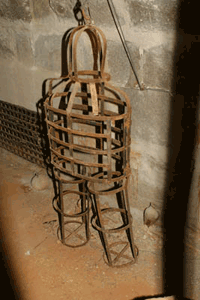
A fun fact about the Gatineau Tower is that it was actually used as a torture chamber because the ventilation was blocked and not working properly when the tower was in use.
It became apparent to Sultan Suleyman the Magnificent of just how invincible the Knights of St. John were. During the night of July 29th, 1522, Suleyman decided to siege the Knights of St. John and this battle would last 4 months and 23 days. During the heavy siege, both sides would end up receiving significant losses and casualties.
On December 22nd of 1522, the Knights finally surrendered but had an agreement they wanted to uphold.
The agreement stated that the Castle of Rhodes along with islands in coordination with 12 other islands which included Cos/Istankoy along with Bodrum Castle would take over control of the Turks in just 10 days. Bodrum Castle had no choice but to surrender while being outnumbered on the 5th of January 1523. From there, the Turks proceeded to bury the Dungeon room and wanted it to be completely gone from history.
If you visit the Ganiteau Tower, you’ll notice there’s three separate coats of arms. The first arm you’ll notice is Magnus Magister Emery D’Amboise which ruled from 1503 to 1512.
Then, you’ll have Jacques Gatineau who was responsible for a lot of the construction of the tower. To enter the tower though, you’ll have to take a flight of stairs which consists of 23 steps leading down to the tower. An eerie message hangs above the inner door which says “INDE DEUS ABEST”, which in Latin means that God is absent from this place.
If you look down from the balcony, you can actually see the torture chamber from there. There are two smaller chambers that are accessible from the east and the west. There’s a ventilation shaft which hangs above the entrance and there’s also an old cannon room.
The reason Turkish people wanted this room gone so bad is because during the period of time that this dungeon was in use, Turkish prisoners were held in this room captive and tortured for information.
One of the most notable tortured members was Orcu Reis, who was an older brother of the Admiral Barbaros. It was while he was returning from the victory in Trablussam that he was under attack by The Knights. Oruc Reis was wounded in the battle and captured but his brother Llyas was killed during the confrontation.
He spent 3 years in prison from 1503 to 1506. He only spent one year in the torture chamber until he redeemed himself worthy and then was sent to the Rhode Island Castle prison.
There are writings and articles by people who recall Oruc’s torture and his stay in the chamber. It was noted that he was to be tortured severely including details such as his hands along with his feet being beaten with heavy iron chains. He was only fed enough bread and water to barely keep him alive. The very mention or imagery of a dungeon reminds people of the fear and pain that people had to endure.
Since then, a lot of people and activists have been working towards giving everyone equality so that they can live without pain, without cruel and unusual punishments and without torture.
The Bodrum Castle serves as a very harsh reminder as to what some of the people had to go through in these dungeons and what people had to endure just because they were on the opposite side of warring factions.