
In the Carian Princess exhibit, you can find a lot of rich history and historical information on Halicarnassus, which was one of the most prominent figures of wealth at the time. This exhibit stands proudly in the once known city as Caria where the Bodrum Museum stands today.
It’s impressive that this dynasty was thriving until Alexander the Great toppled their empire. The Hecatomnid dynasty once ruled Caria from 392 BC until Alexander came with his massive army and crushed the dynasty.
Once the Macedonian armies ravished the land, the Hectaomnid dynasty land never fully recovered and eventually fell. The exhibit serves as a memory and a tribute to Ada I, which was a ruler that was once deposed but reinstated once she adopted the conqueror of her land as her very own son. We never said history made sense or that the things people did back then were reasonable.
The date was April 1989, when a construction and digging crew began to unravel a new and mysterious find.
There was an ancient buried structure that they came across and what was more fascinating about this find is that it was located next to a very well-known necropolis. This necropolis was located near the city of Halicarnassus which is an ancient city of a lot of historic treasures and history. Once the area was discovered to have history, the Bodrum Museum began to supervise the excavation process.
Once they started digging, they remarkably discovered an un-phased sarcophagus which contained the remains of a human female. There was a burial chamber that was still fully intact as if the chamber had been built recently but perfectly reserved.
They immediately determined the deceased woman was someone of wealth due to the amount of jewelry worn and the surroundings of their sarcophagus. It was determined that the remains could’ve been dated back to the Hellenistic Early Roman period. The Bodrum was quite excited at this find because many believe it could belong to the Hecatomnid ruler that watched over ancient Caria.
This was a thrilling find for a number of reasons. Once they found the body, scientists and archaeologists immediately began to start reconstruction of the head to find out what the original person may have looked like. It was spear headed by the Department of Forensic Science at the University of Manchester Medical School.
This very school has helped the police with multiple criminal investigations where a situation was presented that a victim was unidentifiable.
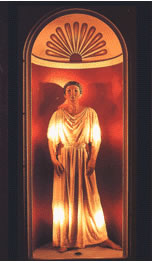
Dr. Richard Neave was the head of this re-construction and this wasn’t an easy task. The overall result of this scientific study is now fully on display in the exhibit and it portrays a woman with very distinct facial features. It showed the features of a woman who would not be a stranger to the area and seemed to reconfirm that the woman found was from the area she was found in.
The age however was a bit difficult to determine as the scientists came to the conclusion she could’ve been anywhere from 38 to 50 years old with a hard estimate at 44 years old. This estimate was confirmed by Dr. R.W. Stoddard in the Pathology department.
However, the main problem with these scientific investigations is that the facts haven’t been proven yet and there’s no solid evidence that points them into a clear answer. They haven’t been disproven either.
However, there’s no doubt in any of the researcher’s minds that the body did belong to someone of significant wealth or someone who was of a noble background. A lot of researchers are pointing to evidence that indicates this person was a Carian Princess and some people may believe she could’ve been Ada I from the Hecatomnid Dynasty.
By the support of the Turkish Ministry of Culture, this exhibit was opened as early as 1993. While it’s not officially proven that this is the body of a Carian Princess, a lot of evidence supports the notion that it was and that’s what this exhibit explores. Historians believe that a Carian Princess spent most of her days in the banquet hall where guests would appear with gifts and jewelry. Only the richest of coins, gold and jewelry would be given to the princess. People believe she was alive nearly 2,400 years ago.